Learning the days of the week is really three skills wearing one costume: reading and writing seven brand-new words, putting them in a fixed order, and then moving around inside that order (today, tomorrow, yesterday). Jump straight to “what comes after Tuesday” and you lose the kids who cannot yet read “Tuesday.”
The eight free worksheets below climb that ladder in order: trace the words, spell them, sequence them, then reason forward and back. Every one is a printable PDF with no account and no watermark. Drop in wherever your class already is.
Days of the Week: Say, Trace, Write

Start here. This is the one sheet that meets every child where they are: a three-column table where they say each day out loud, trace it, then write it on their own. The scaffold is built in, so the same page works for a child still learning the words and one ready to write them solo.
I reach for it first because it quietly does the differentiation for me. Spread it across a week, a day or two at a time, or hand it to a confident class all at once.
Let's Write the Days of the Week
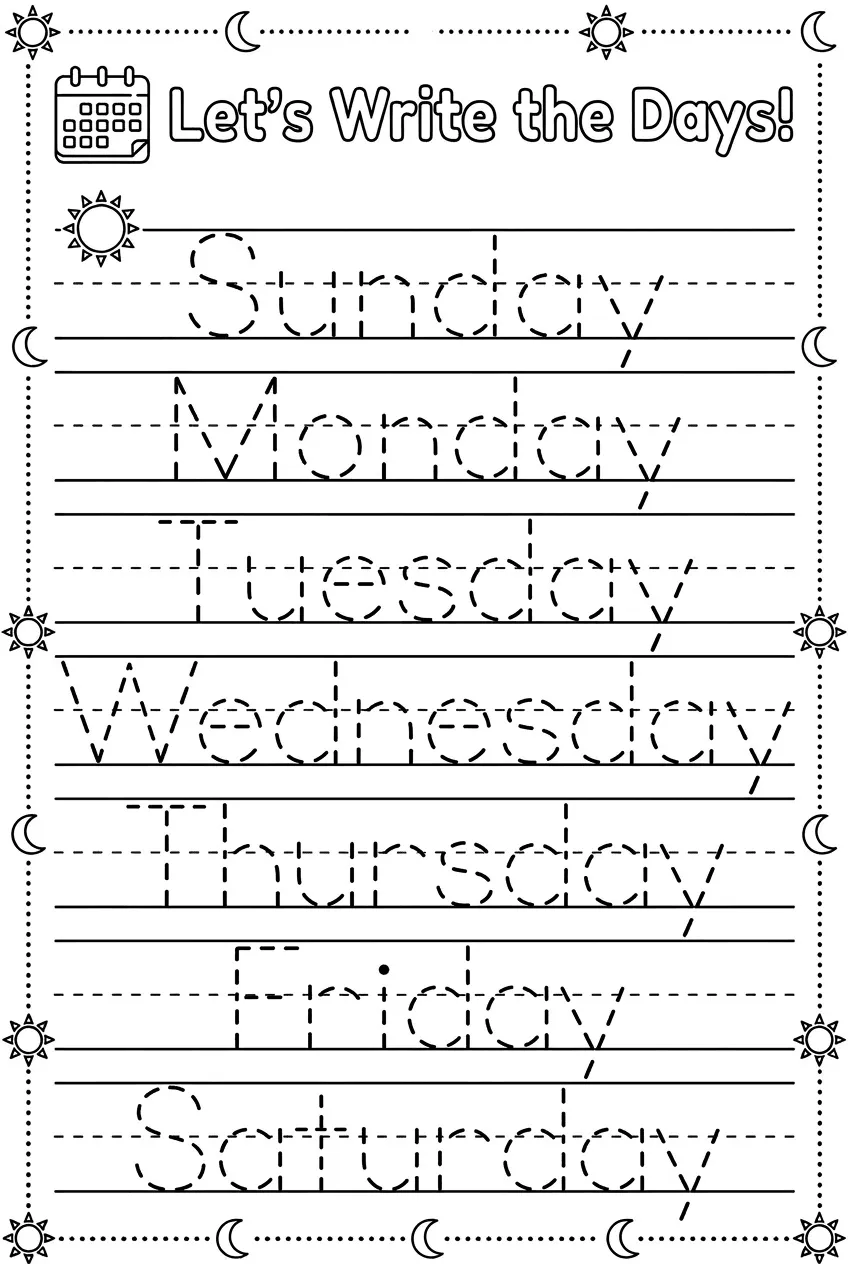
Pure handwriting practice: seven guided lines, one per day, with large dashed letters to trace inside friendly rules. It's the gentlest on-ramp for little hands still building pencil control.
Days of the Week Tracing

Same tracing focus, with a twist that matters in a lot of classrooms: it runs Monday first. Each row shows the day in bold on the left to read, then a trace line on the right, so recognition and handwriting happen together.
Days of the Week Fill-in-the-Blank

Once the words look familiar, this nudges children from recognizing them to spelling them. Each day appears with missing letters next to a friendly picture cue, and kids fill in the blanks to finish the word.
The Seven Days of the Week

Now the order. The seven days sit scrambled on the left, numbered boxes 1 to 7 on the right, and children write each day in its place. A growing-plant illustration down the side reinforces that the week moves in sequence.
Days of the Week: What Comes After?

A focused follow-up to ordering: each box gives three days in a row and asks for the one that comes next. A word bank up top keeps it about thinking forward, not recall under pressure.
Days of the Week: Tomorrow and Yesterday

The trickiest leap: not just naming the days but moving around in them. Each colorful row says 'Today is...' and asks what comes tomorrow and what was yesterday, with a reference strip of the week to count along.
Which Day Comes Next?

The same tomorrow-and-yesterday thinking, stripped to clean black and white for an independent check. Five panels, each naming a day and asking for the one before and after. Ink-friendly and quick to print for a whole class.
One more thing.
If your kids finish a unit and you're not sure what to do next, my honest advice: don't move on yet. Spend a week mixing these in as warm-ups. Fluency isn't a unit, it's a habit, and the sheet that builds it is usually the one they ask to do again.